Why Catholics are Terrible At Fundraising (And What to Do About it)

I’ve been fundraising for Catholic organizations for several years now, and I have been blessed to meet so many incredible Catholics who work and volunteer for them.

Why Catholics are Terrible at Fundraising

Most Catholics get involved because they want to make a difference. They want to help a cause that is bigger than them. They love their Catholic faith and are passionate about helping others. I am delighted to meet so many of these people, as they motivate me to keep helping Catholics raise money to do extraordinary things.

However, when they come to me for assistance, I find their challenges with fundraising usually revolve around one key issue: Catholics find it difficult to explain concisely and clearly what they do. This challenge is not unique to appeals either.

It’s important that you can explain your mission even before you ask for donations. Therefore, to improve your fundraising, I recommend you do the following five steps:

  1. Know how exactly how to articulate what you do (in one to two sentences).
  2. Share what you do with other Catholics (without asking for money)
  3. Provide opportunities for Catholics to learn what you do
  4. Regularly share stories of how you are succeeding in your work
  5. Build relationships with people (especially your donors)

The biggest roadblocks in fundraising aren’t about asking for money because it goes beyond asking people for donations. Yes, you heard me. Fundraising is about connecting with people and inspiring them to give.

If you can connect with them, you can inspire them. And, if they are inspired, they will donate.

Discussion Question: How can you tell your charity’s story better to the people around you? (Please leave a comment below)

NOT SUBSCRIBED TO RECEIVE THE WEEKLY CONTENT? FIX THAT! IT’S COMPLETELY FREE.


5 Important Steps to Getting Your Board, Volunteers, Colleagues Involved with Fundraising

How to get your board involved with fundraising? I regularly conduct fundraising workshops for Catholic charities. One subject people often asked about is regarding who does what when raising money. In particular, Catholics are interested in how to involve their board, colleagues, and, most importantly, their armies of volunteers.

These are important questions because you cannot fundraise alone. If you leave the fundraiser (development director, etc.) in a corner to do everything by herself, your Catholic organization has dramatically fewer opportunities to raise funds. This is true about your current and long-term situations.

You cannot fundraise alone. This is why dioceses and large charities spend thousands, if not millions, on external fundraising firms. They know that they require help to move their objectives forward. You, however, don’t need to spend massive amounts of money to get the same help.

I will outline in precise detail who does what right here.

Here are my five recommended first steps to get people involved with fundraising.

Step 1 – Plant seeds before asking for money

Fundraising is about planting seeds, watering them, and allowing them to grow over time. One of my favorite verses in the New Testament to reference when talking about fundraising is 1 Corinthians 3:6, “I planted, Apollos watered, but God caused the growth.”

With this phrase, Saint Paul provides us the foundational block for taking our first step with fundraising.

Just imagine the enormous task God placed before him. He understood that to be successful, he first had to plant seeds: initial conversations with people about his work. Then, he gathered a group of helpers to develop those conversations into relationships. Third, Paul and his colleagues let God do the rest.

Fast forward 2,000 years, and we know the results of Paul’s approach. Therefore, I recommend you take the same path.

Also, your first conversations with people don’t have to be about donating. That is likely too much of a hurdle for most people. Start small by sharing with them your vision. In the same chapter, Paul writes, “I fed you milk, not solid food because you were unable to take it.” – 1 Corinthians 3:2

Last, make sure you have a team of helpers that help build those initial conversations into meaningful relationships. This means not asking your helpers to raise money. Focus instead on the person: who are they? What inspires them? How do they want to get involved?

You can learn more about planting seeds in this blog: How planting seeds increases donors ten fold

Step 2 – Get the right people, not lots of people, to help you

You don’t need a lot of people helping you either. Just a core group of volunteers help you build relationships each day will do wonders. It’s not a numbers game. There is not a direct connection in how many people help you to how much money you raise.

Often, more people helping you fundraise will have the opposite effect. It becomes more management than you initially wanted it to be. You will likely be more stressed from constantly checking who has done what or not done.

Also, when too many people are involved, people start assuming that if they don’t finish their tasks, someone else will fill in. Therefore, having an army of people (or volunteers) involved in fundraising won’t help you reach your target. Better to have a few committed people working closely together with you.

Step 3 – Avoid recruiting people who live ‘busy’ lives

I recommend that you be selective with who helps you. Rather than sending a blanket request and accept anyone who responds, I find a selective approach to be more beneficial. Why? Some people assume that, because they are a volunteer, they won’t have to do much (or not even follow through).

It’s just the unfortunate circumstance of our modern age. People are busy. I dislike this word. When someone uses this word, I think it means that they are overstretching their responsibilities rather than admitting they don’t have as much time as they thought. They don’t focus their time and energy. As a result, they burn themselves out along with them people around them.

And, when it comes to charitable work, many people see volunteering as something done on the side. It’s an add-on to all their other activities (particularly family and work). Therefore, if they are living busy lives, when that moment comes where they hit a wall and cannot juggle all the responsibilities, volunteering tends to be one of the first activities to be cut. This means you and your Catholic organization.

Therefore, I suggest you keep an eye out for people who are diligent and consistently willing to complete tasks. This is especially true when it comes time to recruit new board members. You don’t have to ask for people’s resumes and interview them. Instead, you learn who will be a good fit just by getting to know them. If they stay committed to finishing tasks, it’s a good sign they will be a great board member.

You can read more about board involvement in this blog post: 3 Qualities Leaders Must Have to Boost Fundraising

Step 4 – Define specific tasks for specific people

I also recommend you designate roles and responsibilities. This means certain people do certain tasks. This also means certain people do not do certain tasks.

I have found that everyone has specific talents, as the parable reminds us. (Matthew 25:14–30) It’s our responsibility as fundraisers to assign tasks to people who have the talents to complete them. Some people are better at asking for donations, while others are better at spreading the word (planting seeds).

Check out this boast on overcoming your fear of asking for donations: How to Embrace Your Fears When Fundraising

Step 5 – Keep a list of key roles and responsibilities

My best fundraising campaigns happen when I keep track of the people, their roles, and their responsibilities.

These roles include:

  1. You, the fundraiser, and your team – you are responsible for managing all aspects
  2. Your board members – involved in approving how fundraising operates but also partake in the asking
  3. Your leadership team – involved in all aspects, includes asking
  4. Your colleagues – have specific tasks, doesn’t always include asking
  5. Volunteers – have specific tasks in spreading key messages, rarely includes asking
  6. Clergy – they must be active in the entire fundraising process (even asking and giving)

In the next chapter, I will explain in further detail what each group does and why.

As you notice from the list, not everyone is asking for money. However, the decision of who does and does not ask goes beyond comfort levels. Having the talent to ask for donations should be a prerequisite for any leadership position in your Catholic organization. Having a talent doesn’t always mean it is easy to use. Sometimes, the activities we are best at are the ones we also find most challenging yet fulfilling.

Question: What other steps have you used to get people involved in your fundraising campaigns? You can leave a comment below.

NOT SUBSCRIBED TO RECEIVE THE WEEKLY CONTENT? FIX THAT! IT’S COMPLETELY FREE.


How to create an amazing Catholic website

You may already have a website or have been thinking of building one. Whatever the case, promoting your Catholic work online is one of the most significant steps you can make to attract prospects, find donors, and raise funds.

Just imagine how many more people could connect with your mission with a website? They could see photos of what you are doing, read stories about how you are changing lives, and engage in your work by attending an event, volunteering, and donating. Additionally, as a website is running 24/7, it can continuously promote you as you focus on your work.

website-build

However, you may think that building a website is not that straightforward. Computers and software may not be in your skill set. I agree. It can be quite daunting to learn about this brave new world, but you’ll be glad to hear that over the past few years, website building and maintenance have become much easier to manage, even for someone with minimal or no experience.

Just in case, if you have any questions about how powerful a website is for reaching people or want to know what Pope Paul VI said about how the Church must use social communications, read an article I wrote on the Misconceptions of the Internet.

I want to share with you 20 online tools that you can use to set up your website in less than a day. The tools will provide you with a fully functional site, and the best part, you will not have to spend thousands on development or software. In fact, most of the tools that I list are free and function with a few clicks of a mouse.

Website Hosting – Before you build a website, you must have a physical place to store it so people can find it and click through the pages. Think of hosting as the land which you build your house. A hosting service makes sure your website is available 24/7, allowing people to visit it anytime they wish. The two most popular hosting companies are Bluehost and Godaddy. Monthly service plans can start as low as $4.

Domain Name – You will have to give an address to your website which allows people to find you. Think of it as the post address which people can use to find you. I purchased www.catholicfundraiser.net for around $15/year. You can buy a domain directly through Bluehost or GoDaddy when you purchase hosting services. The benefit of doing this is the hosting service can directly link your domain (your address) name to your web hosting (your physical location).

Website Platform – You will then need a website platform that allows you to publish pages, posts, photos, media files, and anything else you want to show people. A web platform is also called a Content Management System. Think of it as your house which sits on the land you purchased (web hosting) and is found using the address (domain name). 20% of all websites run on WordPress, and I recommend you use this platform, too. It’s easy to use, familiar, and if you ever have issues, hosting services such as GoDaddy or Bluehost can help you resolve them immediately.

Website Theme – You will want to select the colors, fonts, styles, and formatting of your site so it matches your organization’s brand. The great news is you don’t have to pay a web developer thousands to edit code for you to get the look you want. You can avoid these costs by using services such as Optimizepress or Rainmaker which offers a variety of themes, Michael Hyatt’s Get Noticed theme is also a great option.

Web page Building – You can use services like LeadPages to design specific web pages for promoting an event or campaign. Their web building tools allow you to click and drag the different pictures, text, sections, and buttons to make the perfect page in minutes.

Social Sharing Buttons – It’s important to offer your readers the ability to share your content with their social networks. Research estimates that each person on Facebook is connected to 250 people. Therefore, you want to offer anyone who comes to your website the ability to share your content with their networks. Just imagine if 100 people shared one of your pages, another 25,000 other people would automatically see it. Therefore, having share buttons is an essential part of a website. I recommend using a tool called Sumome.

Email Gathering – 70% of all visitors to your website will never return. However, people who do visit your site may want to keep in touch with you via email. Research has found that email continues to be the number one most effective way (even beating social media platforms such as Facebook) to stay in touch with people. Therefore, you want to collect people’s emails when they visit your website. You can then send updates directly to their inbox. I suggest tools such as Mailchimp, Aweber, or Campaign Monitor.

Events – I recommend using Eventbrite to manage ticket sales, RSVPs, registration, and payments of your event.  Eventbrite is one of the most popular event-planning platforms on the internet and is easily recognized and used by people. I also like this tool because it allows people to immediately place your event on their calendar. This way they don’t forget to come. They even offer a WordPress plug-in, allowing people to register directly on your website.

Social Media Posting – I recommend using tools such as Hootsuite or Buffer to publish your website content on your different social media channels. With a few clicks, you can post a photo, blog, or event on multiple social platforms (Pinterest, Instagram, LinkedIn, Twitter, and Facebook) from one of these tools, saving you the time and energy from going to each platform individually.

DesignCanva makes design simple for everyone. You can create in minutes beautiful infographics, presentations, Facebook and Twitter covers, flyers, posters, invitations and anything else you can imagine. Canva also offers a library of templates you can use to get you started.

Surveys – I have found one of the best ways to engage with people online is to ask them what they think. I use tools such as Google Forms or Surveymonkey to write surveys and questionnaires which help me learn what interests people. Their responses provide me the information to improve my content and engage with my audiences better.

Blog Commenting – The Disqus plugin allows people to comment on your blog posts, stories, and articles using their social profile (Facebook, Linkedin, Twitter). This is extremely useful because people can then automatically post what they said onto their social feeds. Their networks can then can read what they wrote and learn about your website.

Editing – I recommend using Grammarly to edit your stories, articles, and website text. The tool will check grammar, syntax, and even recommend different words to use so your writing flows better.

Payments and Online Donations – There are countless options for how to collect and process donations. I don’t recommend using a payment platform (apart from PayPal) that requires people to leave your website for theirs to complete the transaction. Research has shown that individuals who leave a site don’t complete the payment as often as if they had stayed on the original website. Rather, use these third party platforms for people who wish to sponsor an event on your behalf.

Instead, I recommend using Stripe, Samcart, Authorize.net, CommitChange, or E-Junkie, which all allow people to stay on your website to complete the transaction. Another benefit of completing the transaction on your site is that you can immediately direct the person to a thank you page and send them a thank you email. This dramatically helps the donor feel they’ve not only supported your work but has also deepened their relationship with you.

Live Chat – Online chat tools are gaining traction because they offer an excellent way to anyone visiting your website to ask a question directly. For example, if the person has difficulty finding information on your site, they can just type in the chat box their inquiry: “What time is Mass at St Mary’s Parish?”. You can then answer immediately, rather than through email which has a time detail. This tool makes you stand apart from every other organization’s websites which don’t often offer a personal level of interaction. You can use tools such as Drift, Olark, and Live Chat Inc.

Website Analysis – I recommend opening a Google Analytics account to monitor how people interact with your site. It’s important to know how people use your site, what they find interesting, and how they come to visit you. With this data, you can make regular adjustments to make your website even more appealing and useful to visitors. You can read this article for further instructions on how to leverage analytics on how to attract 1,000,000 people to your website .

Photos – There are several online libraries of free, high-quality photos. Just double check the usage rights as some ask that you make reference to the photographer and where you found the picture. I recommend the following sites: unsplash.com, pixabay.com, www.flickr.com, gratisography.com.

Video – I recommend not uploading your videos directly on your website because they will take up too much space and slow down how quickly your pages load. Instead, I suggest a tool that allows you to display the video on your pages without being saved on your site. You can use one of the following options: Vimeo, YouTube, Wistia, or Rawshorts if you want to add visual aids to your videos.

Relationship Management – Managing the relationships you have is one of the most important tasks you have in your organization, particularly fundraising. Whether someone is a donor, volunteer, or just a contact, you must be able to quickly and easily manage each person’s details and your relationship with them. I recommend using tools such as Salesforce or Infusionsoft.

My preference is to avoid tools unique to the charity sector because most become obsolete after 5 to 10 years, and it can be challenging to migrate all of your data onto another software. Also, most software solutions designed by the profit-sector integrate with nearly all other software, offering you a much longer-term solution.

Pop-up Windows – While pop-ups can be distracting, they do allow you to get people’s attention to specific information. You could notify them about an upcoming event, latest news, or a request to stay in touch. I do recommend learning how pop-ups can best help your organization interact with your website visitors. You can use tools such as Optinmonster, Rapidology, or if you are using LeadPages to build web pages, you have access to their library of pop-ups.

Question: What online tool do you currently find most useful on your website?

Please let me know what you think by leaving a comment below.

NOT SUBSCRIBED TO RECEIVE THE WEEKLY CONTENT? FIX THAT! IT’S COMPLETELY FREE.

*** REMEMBER TO CLICK THE SHARE BUTTONS AND TELL YOUR COLLEAGUES, PARISH LEADERS, PARISH PRIEST, AND OTHERS ABOUT THIS ARTICLE. THANK YOU. ***


How to have 1,000,000 people visit your Catholic website and donate

How to master online fundraising? I used to think that having a great website meant having great photos, interactive graphics, a mobile-friendly interface, and fun content about what my organization does. Therefore, that’s what I did. I created beautiful and exciting websites for charities, thinking the fresh look would attract people and donations.

Well, after testing different styles and researching what works and doesn’t work, I found that my assumptions were wrong. I wasn’t attracting people, and I wasn’t raising many funds. If anything, I spent a lot of time and money on a website that did not produce many results.

catholic-website-found

While the look of a website is important, I discovered that you must have a sound basis before the site will attract people and bring in donations. You may have high-quality photos that move from left to right with the click of the mouse, but if the foundation is not in place, all that work will not mean much because few people are visiting your website. And the fewer people visiting translates to fewer people donating.

“Everyone who listens to these words of mine and acts on them will be like a wise man who built his house on rock.” – Matthew 7:24

What do I mean by a strong foundation for your website?

A strong foundation refers to the elements you place that make your website visible to people when they browse the internet. The more people who visit your website means more possibilities for online fundraising.

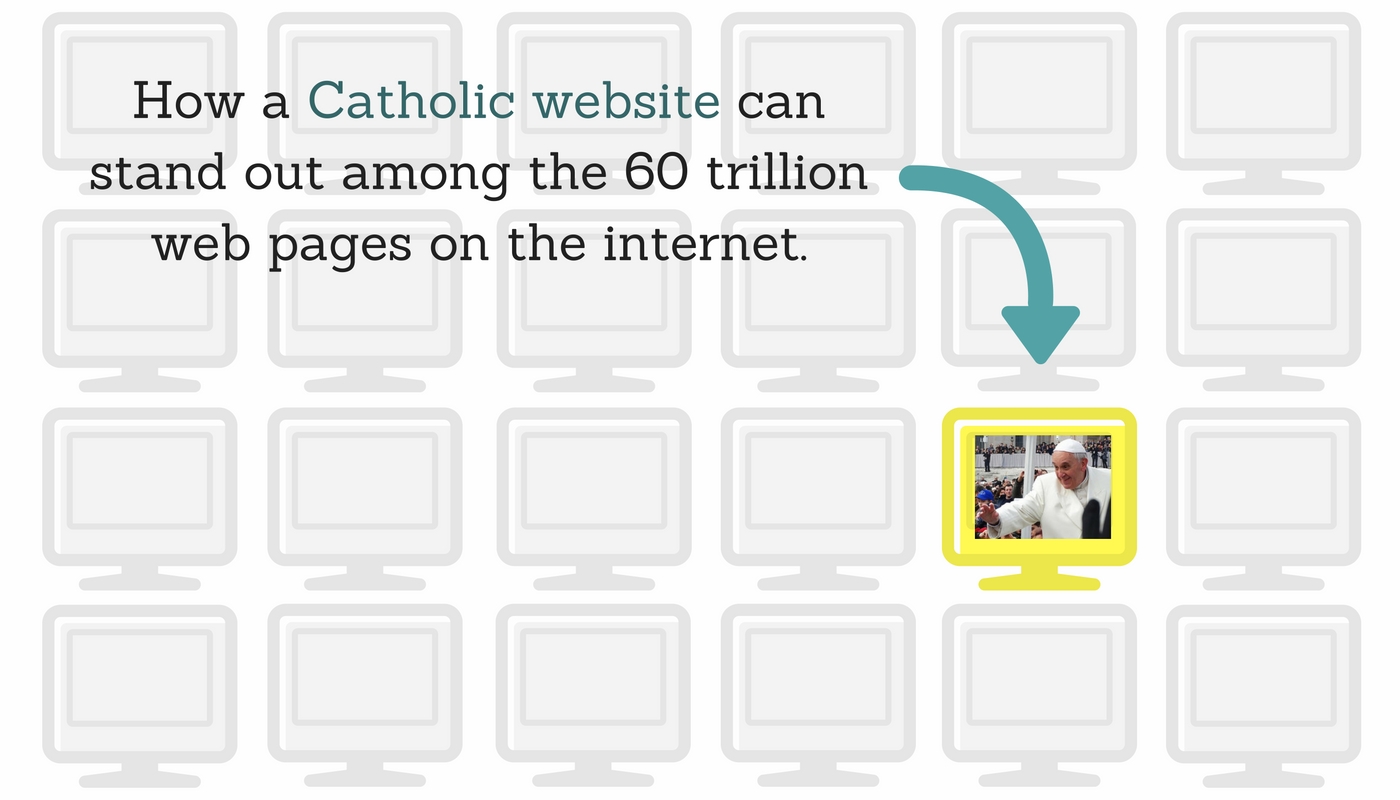
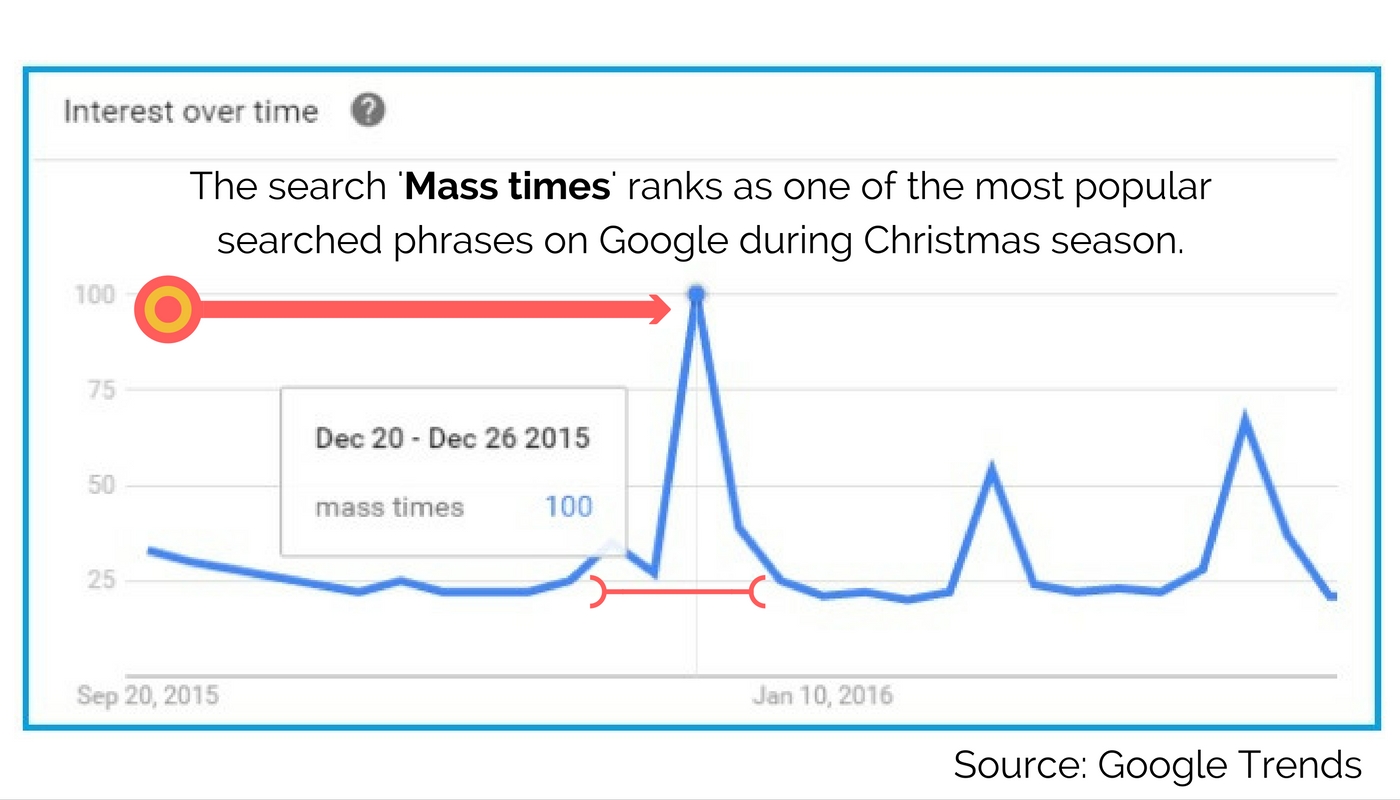
Google estimates that there are 60 trillion individual pages on the web, and this number increases daily. Each day over 3.5 billion searches are completed. I looked how often people search ‘Mass times’. The score of 100 in the chart below means the search (Mass times) ranks at the top of all Google searches during Christmas and Easter.

2

You can use the Google trends tool to look up how popular any word or phrase is.

These statistics are important for two reasons. First, they confirm that people are interested in Christianity. And second, people are using the internet to discover more about the faith. This is good news because it means we can use the internet to attract people to what you do.

How then do you attract these millions of individuals to your website when they have 60 trillion options? My research has uncovered the four foundational steps to attract more people to your website, increase engagement, and therefore increase donations.

Step 1: Make sure people can find your website.

It can seem daunting to think anyone will find your website among these trillions of pages. Or, you may just assume that anyone who is interested in your ministry will eventually discover you on the web. Well, both of these assumptions significantly reduce the number of people who do arrive at your homepage.

For example, when someone searches for a Catholic church in their area, you will be surprised how many protestant communities will appear above your website in the results. You will be even more surprised by how many of them describe themselves as Catholic. I’ve come across a few. I’ve also come across evangelical communities who quote either the Pope or a Catholic saint. I guess their strategy is to pinch lapsed Catholics or anyone else who searches for a local Catholic church wanting to get learn more about the faith.

Regardless as to why Protestants do this, the fact is when people search for Catholic content, they unsuspectedly find at the top of search results non-Catholic material.

Luckily, with a few minor adjustments, you can avoid this from happening. I recommend using the Google Search Console to check that Google and other search engines know your site exists and correctly categorize the pages.

Search engines like Google crawl (collect data) the internet looking for websites. Once they find yours, they then analyze the content, index each page based on the keywords, and then rank your site based on several factors. These factors include the words you use on each page, the number of external links to your website, the number of visits per month, and how often you update the content.

To improve how high you rank in search results, Google also offers instructions on how to make your website more visible. Because Google wants to provide its users with the best search results, the search engine has a vested interest in people correctly explaining the content of their websites.

Step 2: Use words that match what people search.

The words that you use on your website have vital importance in how often people find you on the internet. You may think that people find your site because they searched specifically for you and your work. This is rarely the case. Most people come across your website because the words you use match the words they searched.

For example, if you are a young adults ministry, more than likely, a young adult or parent will search upcoming Catholic youth events, networks of young Catholics in their community, and useful resources for young Catholics. If your homepage displays your mission statement, photos of past events, and generic information about what you do, and countless menu options on the particularities of your ministry, your website likely won’t be at the top of the search results. Therefore, fewer people will visit your site.

Therefore, if you want to increase the number of visitors (thereby increasing engagement with your organization and eventually donate to you), I recommend that you use words that match the most popular words used in searches. You can easily do this by using Google’s Keyword Planner. This free tool tells you what words people most frequently use when searching for your kind of content. It also recommends other favorite words you can use.

Selecting which words you use is beneficial for two reasons. First, you match the words people are looking for when browsing the internet, thereby directly giving them an answer to their query. And second, Google will rank you higher in search results because you are matching what its users want to find.

Let’s take a practical example.

The top searched words for the topic ‘pro-life’ are as follows.

– Abortion
– Human rights
– Pro-choice
– For life
– Abortion facts

You will notice that the word pro-life doesn’t rank among the top five. Therefore, you want to use these words on your website to attract more people because that is what people are typing in the Google search bar.

What’s even more interesting is to look at the keywords of Planned Parenthood.
– Abortion pill
– Birth control pills
– Abortion clinics
– STD testing
– Emergency contraception

Now, you can use these words on your pages to attract people to your website who are considering an abortion. How wonderful would it be to have a pro-life website rank higher than Planned Parenthood’s site? It’s possible if you use this strategy.

Therefore, rather than only displaying information about who you are and what you do, I suggest that you research what words people are typing in their browsers. You can also use CoSchedule’s free Header Analyzer to help you write sentences with these keywords that attract people’s attention.

Step 3: Provide visitors with the most useful information possible.

When hosting an event, you can get a sense of how people engage with you by observing what they do. With this information, you can make your next event even better. Web analytics can do the same for your website by telling you how people interact with your site.

I do want to explain that web analytics is not like spying on someone’s personal information. Rather, just as you would observe someone at an event, you notice what the person does, what he says, whom they speak with, and how long he stays. Analytics offers you the same information for your virtual event: your website.

When someone browses your pages, web analytics tracks what content people are reading, how long they stay on each page, and how much of a page they look at, all the while letting the person remain anonymous. The analytics are then presented to you in a way that helps you understand what people do when visiting your website.

You can then make the necessary changes to improve your content, providing people with even more useful information. As you do this more and more, Google will notice that people are visiting your website more often and spending longer periods of them. As a result, your website will be ranked even high in search results, thereby increasing the number of site visitors. You can see why web analytics are an essential part of a solid web foundation.

I recommend using Google Analytics which is free. In particular, I suggest reviewing each month these five pieces of data:

  1. The number of unique visitors
  2. The top three pages viewed
  3. The top three clicked links
  4. The top five sources (how people arrive at your website)
  5. The conversion rate of each page (contacted you vs.total number of visitors)

By tracking this data, you will know how to make your site more useful and relevant. Are people interested in what the pope said? Are they looking for who God is? Do they want to know where you are located and when Mass is? Who is visiting your website? Are they practicing Catholics, lapsed Catholics, or non-Catholics? If you find that the majority of people visiting your website are reading the page ‘Who is God?’ or ‘How to become Catholic?’, you can assume that they are not Catholic.

By knowing your audience, you can provide more useful information. The more people see you as someone who is knowledgeable and resourceful will translate to improved online fundraising. You could also remove that annoying donate button which no one clicks. Even though I am a fundraiser, I don’t think displaying this button on your homepage is the best way to say ‘Welcome to the Catholic Church’! Why? Let me explain.

Let’s look at an example

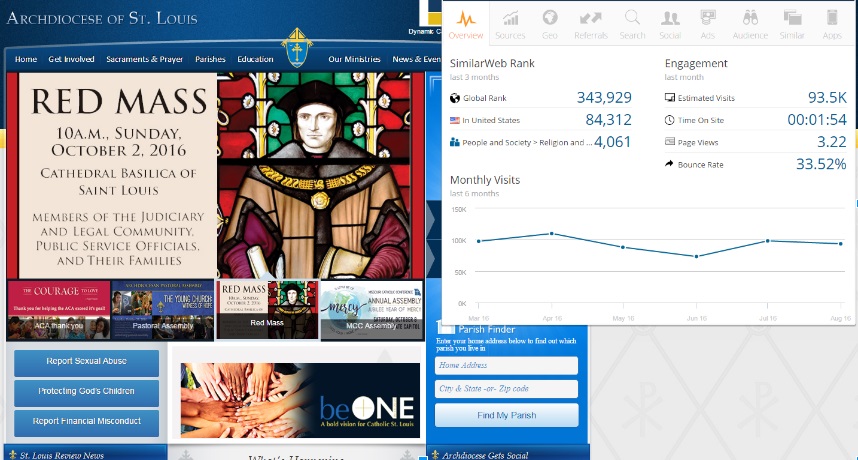
Take a look at the web traffic statistics for the following four diocesan websites.

Diocese Local city population Number of Catholics Monthly website visits Yearly website visits
New York
archny.org
5.85 million 2.64 million 30 thousand 360 thousand
St Louis archstl.org 2.23 million 500 thousand 90 thousand 1.08 million
Chicago
archchicago.org
6.25 million 2.44 million 65 thousand 780 thousand
Houston
archgh.org
6.20 million 1.19 million 50 thousand 600 thousand

Did you notice that the Diocese of Saint Louis has the highest number of monthly visits to its website, even though it has the fewest Catholics? It also has the smallest city population. Therefore, how can they generate so much more traffic? If you visit all four websites, you will see why this is. The Diocese of St Louis has skillfully made its homepage relevant to Catholics, lapsed Catholics, and non-Catholics.

diocese-of-st-louis

Now consider how many people visit each site per year. Among the one million visitors to the Diocese of Saint Louis’s website, how many do you think would be interested in becoming Catholic, attending Mass, or making a donation? Whatever the number is, it is 3x larger than New York’s figure, while having 1/4 the number of Catholics and 2/5 the population. Of course, website traffic is not the full measurement of how effective someone is in evangelizing. However, I can assume that the more traffic you generate to your website increases the probability of people engaging in faith activities.

And because you don’t have to run from parish the parish and spend hours surveying what people think, you can do all this analysis from your desk. This frees more time to actually evangelize and do the work you wanted to do in the first place.

Step 4: Have each page focus on one key point which interests people.

You can attract even more people to your organization’s website by targeting each page to cover a single keyword that is most frequently searched. For example, if you are a local Catholic parish, and you know that people search for Mass times quite frequently, you want one page dedicated to Mass times. This means giving ‘Mass times’ its own page apart from the other sacraments. You can do this for baptisms, weddings, and funerals.

The following five phrases rank the highest in Google searches. Therefore, I recommend you have a web page dedicated to each one of them.
1. Catholic Church
2. Catholic prayers
3. Mass times
4. Catholic Church near me
5. Other Christian keywords such as God, Jesus, and Bible

Take for example the words, ‘Catholic Church near me’. People type this phrase when searching for a church nearby. Therefore, you want to have a page that has these words.

You can tag each page of your website with keywords by leveraging Search Engine Optimization (SEO). It sounds complicated, but SEO is quite straightforward and easy to use. SEO simply means the words you tag a web page with so search engines know what it is about and can index it correctly among the other trillion pages on the internet.

The three key SEO elements of any web page you need to complete are:

Page Title: [High-level description of what page is about. This appears in blue in the search results of Google]
Page Description: [Explains what the page is about in a few sentences. This appears in gray in Google searches]
Page Keywords: [Tells a search engine what the keywords are so it can properly index the page]

You can use free tools such as All-In-One SEO and Yoast SEO to make sure each page of your website is properly tagged.

Let’s take another example.

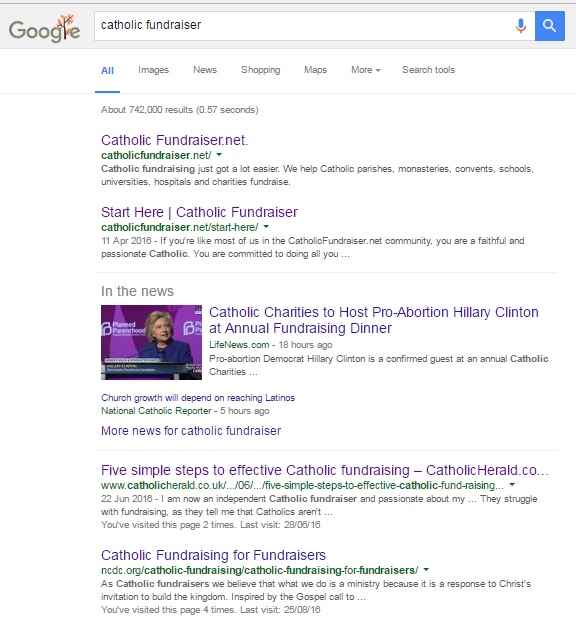
When you type ‘catholic fundraiser’ into Google, my website ranks at the top of the list, beating all the other 742,000 search results and all the other more established fundraising consulting firms. In fact, I have three (one being an article I wrote for the Catholic Herald) of the top five results. I did this without spending any money on advertisements because I simply added ‘Catholic fundraiser’ in the SEO fields to indicate to Google that my website is relevant to anyone looking for a Catholic fundraiser.

search-results

Very few organizations add the SEO details to their pages. This means if you do this simple step, your website will quickly rank higher than there’s. This is why SEO is part of having a solid web foundation. It’s quick, easy, free, and powerful.

How does this all link to online fundraising?

A solid foundation with your website helps you with fundraising because it increases the number of people who know about your organization through the internet. We must take on the responsibility for the evangelization of this “digital continent”, as Pope Benedict called it. Your website is a fresh haven to attract the millions of people who use the internet each day to find answers to their questions.

The key to increase donations is to attract more people’s attention to your work and to have them keep coming back. Your website can do this 24/7 and on a large scale. With so many people looking to the internet for answers, you can point them to the right answers. Catholic answers.

As Jesus said, you must build on rock, not sand. By spending time on these four foundational elements of your website, you can build from the ground up.  Your website, like your home, parish, or religious community, must not be built on sand.

Therefore, before you place prominently the donate button and spend large sums of money on advertising to attract people to your next capital appeal campaign, begin by making sure people can find your website, engage with your content, and consider their involvement. You will be surprised how many people come to you asking, “I’m so happy to have found you. How can I support this incredible work you are doing?”

Discussion Question: How solid is your website’s foundation?

Please let me know what you think by leaving a comment below.

NOT SUBSCRIBED TO RECEIVE THE WEEKLY CONTENT? FIX THAT! IT’S COMPLETELY FREE.


*** REMEMBER TO CLICK THE SHARE BUTTONS AND TELL YOUR COLLEAGUES, PARISH LEADERS, PARISH PRIEST, AND OTHERS ABOUT THIS ARTICLE. THANK YOU. ***
 

Leap of Faith

How I pursued my vocation

I was anxiously sitting at my desk in London, tapping my pen on the table. It was the summer of 2012. The same year, London hosted the Summer Olympics.

The view from my desk was like what you see on postcards. I had an unobstructed, panoramic view over the River Thames, Tower Bridge, and City Hall. With the Olympics in town, all of London was buzzing with excitement, and I was in the middle.

london-1383064_960_720

I, however, was blankly staring at my computer screen. My mind was elsewhere. In five minutes, I was about to make the decision to leave my prominent and exciting career in consulting.

I was meeting with my boss to tell him I wanted to take a six-month sabbatical to work as a fundraiser for the Catholic Church. I thought I was taking a career break, a breather from the constant hustle of the professional world. I didn’t know then that I would never come back.

For my colleagues, the discussions were about their upcoming projects, promotions, and year-end bonuses. I was thinking about the perks of my new job: reduced income, no window view, and no bonus. To top that off, I would be talking every day about religion while asking people for money. What a juxtaposition. In a sense, I saw myself leaving my lucrative career path to become a professional beggar.

I was nervous.

“What’s up, Brice? What do you want to talk about?” Andrew asked.

Andrew, my boss, was one of the partners responsible for leading my team of one hundred professionals. He had always been kind to me since my arrival to the company and the United Kingdom two years earlier. I am originally from the United States, and my career has taken me to San Francisco, Paris, the Middle East, and then London.

As I said, I was leaving an exciting career.

“Brilliant, Andrew. Thanks for taking the time to speak with me.” Then the ball began to roll, and it’s never stopped.

Then the ball began to roll, and it’s never stopped.

As word spread that I was leaving, many colleagues congratulated me on my bold move. I even learned that some of my colleagues were Catholic. I probably would have never known if I hadn’t decided to leave.

“Aren’t you nervous about the future?” one colleague asked, concerned that I was committing career and financial suicide. He was right to ask because I did think, “What is going to happen?” I was anxious about the future, but I found consolation that everything would find its course. I just had to focus on today, not tomorrow.

There were days when I doubted myself

At the time, I worked on average 60 hours a week, with another 10 hours on some weekends. I would occasionally return home from work at 2 am. On top of the workload, I attended night school two nights a week while pursuing a Master’s Degree in Christian theology. Each week, I read 600-page theology textbooks, racked my brain with doctrine and theological concepts, and wrote ten-page essays, which were due every two months.

The pace was relentless.

Some days, when I was too overwhelmed, I would reach the tipping point and panic. I could barely move my body forward when I walked, and my mind constantly entertained thoughts of doubt and despair.

Other days, I just wanted to quit.

I remember one of these days quite vividly. I was so panicked that after work, I rushed to the Polish church next to my house for adoration. I fell to my knees and looked forcefully at the Eucharist, ready to express all my frustration and grill Jesus with questions.

As I stared directly into the Eucharist, a buzzing sound, like white noise or an air-conditioning unit, filled the church. It was so prominent that everything and everyone around me was muted. I couldn’t even hear my thoughts anymore. I felt the Holy Spirit firmly grab me by the shoulders and shake me as if to snap me out of my dark mood. Then, words were spoken to me as if through the buzzing sound, “Calm down, Brice. Just calm down. Don’t worry. Be patient, and trust me. You’ll see. Trust me.”

So, I did.

I learned to let go and trust Christ

I decided to leave my job after a year of discernment. I attended daily Mass, spoke to priests regularly, and went on several retreats to a Benedictine monastery. I continually asked God what he wanted me to do, and I took the time to listen to him and journal what I thought he was saying to me.

Also, as I completed my master’s degree in Christianity at Heythrop, the Catholic college next to my house where both seminarians and religious study, I learned the foundations of my faith and spoke with others who inspired me to take this decision.

I eventually discovered that I didn’t need all the answers to my questions. That’s God’s role. My role was to trust and walk in faith one step at a time.

[Tweet “Faith is being sure of what we hope for and certain of what we do not see. – Hebrews 11:1″]

Gradually, as I walked in faith more, the leap stopped being as daunting as I kept imagining it to be.

“Look, I’m still alive,” I told myself. “I’m healthy and have a roof over my head.”

I settled into this new mindset and eventually found more answers. The most important answer I found was to the question, “What next?” The answer is always to trust Jesus, regardless of what I thought, felt, or assumed, and be vigilant while moving forward.

If I hadn’t learned to do this, I wouldn’t have changed careers, started fundraising for Catholic organizations, or launched this website, and you wouldn’t be reading these words.

Catholic Leadership in Fundraising

3 Ways to Boost Funds through Leadership

Leaders give us the energy and drive to move forward, even when times are difficult. Fundraising, for example, is usually listed as one of the most challenging tasks an organization is faced with. How often do we need leaderships to provide that surge of passion or encouragement to press on?

religion-182162_640

If there is one factor that separates a great organization from a good one, leadership ranks at the top of the list. Not only do we stay focused on what to do because of great leaders, but we also press on with more joy, drive, and energy.

“Our own times require of the laity no less zeal: in fact, modern conditions demand that their apostolate be broadened and intensified.”
Apostolicam Actuositatem, Decree on the Apostolate of the Laity – Second Vatican Council

Why? Leaders have a clear sense that the less we do, the more we accomplish. They greatly influence our ability to focus on the essentials.

Too often, we can drift away from our core tasks because excessive demands flood our inboxes. Leaders recognize this reality and respond by eliminating the non-essentials. They also take on some of these duties themselves or delegate them to others. By doing so, leaders help everyone stay on course, including us as fundraisers.

If you’re a high-achiever like I am, you likely have more projects and ideas than time. It’s easy to think of racing to get as much done as possible. But maintaining focus and limiting tasks are both crucial. It can be incredibly helpful when a leader steps in to remind us what are our core responsibilities and goals. Therefore, great leadership is paramount to raising funds, inspiring donors and keeping the mission going.

As fundraisers, we depend on leaders because they help us understand what we are raising money for, and they inspire us with energy to find these resources.

Here are three leadership qualities that will improve your fundraising immensely.

Quality 1: Set clear and measurable goals

When setting the strategic direction of an organization, define a plan which has clear and quantifiable goals. The plan will turn the vision into reality while the goals will point everyone in the same direction. Together, the plan and goals connect with the fundraising targets so that everyone knows why the funds are needed and how the money will be raised.

If the board of directors sets a goal to double the team size in three years, this translates to more money and an increase in staff. The organizational structure, work habits, and culture will therefore also change. The leadership team sees these interconnections and, in response, lays out a plan to connect, manage and direct everyone to achieve these goals.

I was once asked by the board of a charity to double donations in one year because they wanted to increase the organization’s size. I presented my plan, which the board unanimously approved. However, when I politely asked that they define the overall organizational goals and targets to help me reach the fundraising goal, my words were met with silence. They seemed to assume that I would raise the money first, and then they would think about everything else later.

The results were dismal. For the first six months, I raised zero funds. Once the leaders stepped forward and became more strategically involved, the impact was incredible. Within three months, we not only raised the funds we were aiming for, we raised our yearly target.

Quality 2: Actively involved in fundraising

Leaders take an active role in fundraising by spreading the organization’s message and finding prospects. They do so in three specific ways: (1) donate themselves, (2) recruit donors, and (3) ask for donations.

Leaders should always financially contribute to the organization, giving an amount that is appropriate to their circumstances. Whether a board member is a corporate CEO or full-time mother, she should consider a donation based on her circumstances. Giving financially is important because it demonstrates to everyone, both inside and outside the organization, that the leader is fully committed. Also, leaders know that it is as much an honor for them to be on the leadership team as it is for the organization to have them involved. They, therefore, want to give back.

What happens if a donor approaches your leader saying, “I understand you provide strategic direction and advice to this organization. Do you, yourself, give financially?” What an awkward situation it would be if your leader responded, “No, I don’t give. I do, however, give generously of my time and expertise, and I think that is enough.”

What if your leader instead said, “Yes, I do give financially. I am passionate about what this organization does, and I consider it a great privilege to donate my time, advice and money to this great group of people.”

Second, a leader is directly responsible for recruiting other donors. Consider this scenario: you have five board members, and each has donated between $500 and $2,000 during a year. In total, you have raised on average $5,000. Then, each member recruits five more people to donate $500, raising an additional $12,500. In total, you have now raised $17,500.

This money could have an enormous impact on your mission. While you are the official fundraiser, your whole team should be helping to bring in funds, with the leaders setting an example.

Leaders understand that potential donors look to them for an indication of how well-managed is the organization. An inspired Catholic donor will think, “since the leaders are so involved and passionate about this mission, I know my donation will be used correctly and go a long way.”

Quality 3: Open to change and feedback

Leaders must also demonstrate the virtue of humility in two distinct ways: openness to change and feedback from others, both inside and outside the organization.

Leaders understand that the pursuit of greatness means adapting along the way. They know that the overall goal shouldn’t be to do everything correctly. Rather, the goal should be to do everything better. It is your mission and not individual egos that are at the heart of your organization. Therefore, change is essential.

As a fundraiser, you can confidently present new ideas because your leaders trust you and want to find ways of improving the mission. When you propose a change, a confident leader will openly consider whether and how to implement it.

Leaders also continuously collect feedback on how they and the organization are doing. They want to know what donors, followers, volunteers, staff, friends, etc. think of them and their team so the organization can constantly learn and grow.

Conclusion

Donors are attracted to great organizations. There is a tremendous difference between how much an excellent organization receives compared to an average one. I would say the difference can be as much as 100x more.

A leader’s attitude, contribution, energy, passion, and commitment are all crucial when it comes to fundraising. When an organization’s leader inspires someone, that person automatically ask the question, “How can I be a part of this?”

Leaders must, therefore, demonstrate greatness and become involved in all aspects of the organization, especially fundraising. When your leaders exhibit these three leadership characteristics, you will see the positive financial impact.

A Catholic Fundraiser’s Reading List

My 50 recommended books to read

Reading has been one of the best ways I’ve developed as a Catholic fundraiser. Over the years, I’ve read multiple genres to piece together a fundraising method that is grounded in the Catholic faith and efficient at delivering results.

1

I have compiled a list of the top 50 books which includes a few recommendations from other Catholic fundraisers.

[Tweet “Top 50 recommended books for Catholic fundraising excellence”]

The books cover a range of topics, including creative design, non-profit, writing, public speaking, motivation, fundraising, marketing, business, psychology, theology, and biographies.

  1. Essential Principles for Fundraising Success: An Answer Manual for the Everyday Challenges of Raising Money
  2. The Next Generation Leader: Five Essentials for Those Who Will Shape the Future
  3. Writing That Works, 3e: How to Communicate Effectively in Business
  4. The Temperament God Gave You: The Classic Key to Knowing Yourself, Getting Along with Others, and Growing Closer to the Lord
  5. Fundraising for Nonprofits: How to Build a Community Partnership
  6. Start with No: The Negotiating Tools That the Pros Don’t Want You to Know
  7. The Influential Fundraiser: Using the Psychology of Persuasion to Achieve Outstanding Results
  8. Love Is the Killer App: How to Win Business and Influence Friends
  9. Platform: Get Noticed in a Noisy World by Michael Hyatt
  10. The Desktop Publisher’s Idea Book
  11. Growing Givers Hearts: Treating Fundraising as Ministry
  12. Fundraising for Churches
  13. Guerrilla Marketing for Free: Dozens of No-Cost Tactics to Promote Your Business and Energize Your Profits
  14. Fundraising Management: Analysis, Planning, and Practice
  15. Great Christian Thinkers: From the Early Church through the Middle Ages
  16. Confessions of Augustine
  17. Guerrilla Marketing: Cutting-edge strategies for the 21st century
  18. Bernard of Clairvaux / by Henri Daniel-Rops
  19. Rejection Proof: How to Beat Fear and Become Invincible
  20. Life in Half a Second: How to Achieve Success Before It’s Too Late
  21. The $100 Startup: Fire Your Boss, Do What You Love and Work Better To Live More
  22. Daring Greatly: How the Courage to Be Vulnerable Transforms the Way We Live, Love, Parent, and Lead
  23. Relationology: 101 Secrets to Grow Your Business Through the Power of Relationships
  24. Imagining Abundance: Fundraising, Philanthropy, and a Spiritual Call to Service
  25. Drive: The Surprising Truth About What Motivates Us
  26. Influence: The Psychology of Persuasion
  27. Relationship Fundraising: A Donor-based Approach to the Business of Raising Money
  28. The Oxford Dictionary of Saints
  29. Essentialism: The Disciplined Pursuit of Less
  30. Desktop Publishing and Design For Dummies
  31. Lifelong Activist: How to Change the World Without Losing Your Way
  32. The Life of St. Francis by St. Bonaventure
  33. A Spirituality of Fundraising
  34. Stewardship – A Disciple’s Response – A pastoral letter from the US Catholic Bishops
  35. Discerning the Will of God: An Ignatian Guide to Christian Decision Making
  36. Forming Intentional Disciples: The Path to Knowing and Following Jesus
  37. Grant Writing For Dummies
  38. Storytelling for Grantseekers: A Guide to Creative Nonprofit Fundraising
  39. How to Turn Your Words Into Money: The Master Fundraiser’s Guide to Persuasive Writing
  40. The Fundraiser’s Guide to Irresistible Communications
  41. Making Money with Donor Newsletters
  42. The Trivium: The Liberal Arts of Logic, Grammar, and Rhetoric
  43. The Ask: How to Ask for Support for Your Nonprofit Cause, Creative Project, or Business Venture
  44. People Raising: A Practical Guide to Raising Funds
  45. How to Win Friends & Influence People
  46. Fundraising For Dummies
  47. The Nonprofit Handbook: Fund Raising
  48. Fundraising Basics: A Complete Guide
  49. The War of Art: Break Through the Blocks and Win Your Inner Creative Battles
  50. Busy: How to thrive in a world of too much

Discussion Question: Which books do you recommend reading? Let me know in the comments section below.