Attracting Your Angel Donors

Identifying the people proven to donate 91% of the time

Make sure to get your free copy of ‘The 10 Commandment of Catholic Fundraising’. It’s a book that highlights the ten tasks you should do to keep you focused on your mission and hit your fundraising target, every time.

I have been reading a fantastic book this summer entitled, ‘Who Really Cares,’ by Arthur C. Brooks. In fact, I not only recommend your reading it, I also advise ordering copies for each of your board members and colleagues.

The small handful of dollars you invest in ordering multiple copies this book to distribute among your mission’s decision-makers and development team could lead to rewarding your cause with thousands of extra dollars in donations. Here’s why.

In a previous article, I reviewed the four characteristics of who you should be approaching for donations. You can read that article by clicking here.

How to Fundraise in the Face of a Church Scandal

Faith-driven and authentic Catholic nonprofits can attract distraught donors

Make sure to get your free copy of ‘The 10 Commandment of Catholic Fundraising’. It’s a book that highlights the ten tasks you should do to keep you focused on your mission and hit your fundraising target, every time.

The Catholic Church is hit with another scandal. There’s been a lot of discussion of how a scandal affects how people will donate. (Read this article in the National Catholic Register where I offer my two cents.) The question on many Catholics mind is, “Should I stop giving in light of this scandal?”

While scandals can drastically cut the levels of giving, it can also boost fundraising. In the face of evil, good always prevails. You can find many new donors because Catholics right now are looking for charities and missions which are 100% authentically Catholic.

To do this, you must differentiate yourself from the negative and make Catholics see you as someone they can trust. You can do so by focusing on the character as a fundraiser, development director, board member or whoever is leading the efforts to raise money. This means executing your next campaign or appeal as a Catholic rather than a fundraiser.

Uncovering the roots of stewardship in the Catholic Church

Book review of the fundraising classic, Grateful and Giving

Make sure to get your free copy of ‘The 10 Commandment of Catholic Fundraising’. It’s a book that highlights the ten tasks you should do to keep you focused on your mission and hit your fundraising target, every time.

Monsignor Thomas McGread, a priest in the Diocese of Wichita, Kansas, is well known for his work across the United States in fundraising. He developed an approach called The Stewardship Model, which has helped parishes, dioceses, and national organizations (such as the United States Bishops Conference) raise millions of dollars. You could say he’s the #1 ranked priest in the United States when it comes to how to fundraise for the Catholic Church.

He’s been successful because he’s developed concepts and practices that make being good stewards a tangible reality. Thankfully for you and me, Deacon Donald R. McArdle, CEO of Catholic Stewardship Consultants, documented his approach in the book, Grateful and Giving. This book was written in conjunction with 

This book showcases parishes, dioceses, and national organizations that have been changed through strong and faithful stewardship programs.

I’d like to highlight for you some of the key steps in his program that can serve your fundraising, whatever its level, too.

Happy New Year… now what’s your fundraising plan?

The Importance of Following-Up with People

I want you to accomplish everything that God wants you to do. Whether you are a religious, a priest, a layman, or discerning your vocation, whatever God is calling you to do (even if it seems impossible), I want to help you move forward.

What often happens when we walk in faith, we look to others for support. The assistance we want usually comes in the form of financial donations. Meaning, we have to start asking for donations.

As a result, fundraising adds another level of difficulty to the already challenging journey, wouldn’t you agree?

I want to offer you advice on one of the best ways to get people to assist you financially. Listen to me very carefully because I guarantee you will have significantly better results. You will also stress a whole lot less, isn’t that what we all want? We want to focus more on the mission and stress less about the resources.

The Best Advice for This Year – Follow-Up with People

My advice is to focus significant amounts of your attention on the follow-up.

A follow-up means taking the time to build a meaningful relationship with someone after you’ve asked them for support. You do so by keeping people informed of how you are making a difference, even if they’ve not yet agreed to give financially.

Why do I encourage you to follow-up with people?

Too often, when asking for donations, Catholics forget about keeping in touch with people. They instead ask for money, then get disappointed when the response is negative or non-existent. Then they forget about the person entirely. The relationship disappears even before it can be started.

This common way of fundraising is detrimental to you and your cause. Let me dig deeper and explain why.

I am blessed through my work at CatholicFundraiser.net to work with hundreds of Catholics who are seeking funds. Because of this oversight, I’m able to see the trends and mistakes that Catholics are making over and over again. One of the most significant missed opportunities I frequently see is this inability to follow-up with potential donors.

Brice Sokolowski Catholic Fundraiser

Two Case Studies – One Failure and One Success

Let me share with you two examples to explain why following up with people is so important and how it can transform your fundraising quicker than you can imagine.

Case Study #1 – This is What You Should Not Do

The first example comes from a Catholic family who is passionate about reviving the use of sacred music in the liturgy. While working with them, I discovered they had a fantastic line-up of potential donors. Seriously, some of the people they had met over the course of two months were unbelievable. These were well-known people in the Catholic Church and their community. They had shown interest in the family’s work; however, they weren’t responding to the family’s donation requests.

I recommended that the family keep in touch over the course of three months and try again.

The family, unfortunately, didn’t take my advice. They didn’t see the long-term benefits of building relationships. Instead of seeing each person as a future donor – either in three months, six months, or even next year – the family could only see them as people who would never donate. This is a false assumption.

As a result, the family forgot about these relationships and looked elsewhere. Three months later, they put her project on hold due to a lack of funding, confidence, and direction.

To learn more about what to say to people, and build your confidence in following-up, read this article: How to Find the Right Words When Fundraising.

Case Study #2 – This is What You Should Do

The second example comes from one of the largest Catholic organizations whose mission is to keep Catholics informed about the teachings of the Church. I worked with the development office to build a campaign that would immediately identify people interested in financially giving and focus 100% of our time on following up with each one individually.

We launched the campaign in just a few days because we kept our focus specific to identifying people, asking for their support, and then following up when necessary. Within a month, we had raised $100,000. We also had another $500,000 on the way because of our dedication to following up with people who showed tremendous interest in what the organization was doing but weren’t ready to commit immediately.

Let me reiterate. This campaign took only a few days to get started and reaped significant results for this mission.

How did we do it? All we did was write a few emails, edited a short phone script, and make phone calls. The costs were just time and effort. For information on the how to find donors, read this article: The Art of Finding Donors.

Brice Sokolowski Catholic Fundraiser

The 2 Lessons Why You Should Always Follow-Up

I want you to take away two key lessons today about the importance of following up with the people.

Lesson 1. God always provides. You must pay attention to who God places in your life. I constantly quote Saint Paul: I planted, Apollos watered, and God grew.

I’m a big believer that God always gives us the people and resources necessary for us to move forward. We just have to have our eyes and ears open, and then take action. Meaning, you must keep following up with the people God places in your life.

Lesson 2. Always maintain a log of the people whom you meet. Instead of continually looking for new people to ask for donations, take the time to review the people you’ve met each week. Take note of what they’ve said and consider the best approach to reconnect with them.

Not every person you met will immediately respond with a yes when you ask for a donation. However, don’t disregard the person in the long run. Make a note of the meeting and put a reminder on your calendar to check back at a later date.

Sometimes the best action you can do is to give them an update on what you are doing.

Remember that people donate because they are inspired by what you do rather than by what you say. Keep their attention and remind them of the difference you are making. Then, when the time is right, ask again. Keep repeating this.

Please don’t look at the short term. Be patient – it’s a gift of the Holy Spirit. Follow-up with people regularly and you’ll see that more and more people will support you.

You will succeed with fundraising when you do this: demonstrate for 52 weeks a year “how you are making a difference” rather than “how you will make a difference.”

Question: Who will you follow-up with this week? You can leave a comment by clicking here.

Brice Sokolowski Catholic Fundraiser

3 Steps to Your Best Year-End Campaign Ever

December, Advent, and Christmas are all times when most Catholic charities are preparing their year-end campaigns and appeals. As I talk about the most important month of the year for fundraisers, I get a lot of questions like these: “How do I make sure I’m ready to make the most of December? How do I not be too pushy?”

If you’re asking these questions, you’re already on the right track. Why? Because you’re talking about laying out a plan that will make sure you have an authentic Catholic voice when you do make the ask.

I like to answer these sorts of questions by finding out how well someone’s considered three essential aspects of Catholic fundraising. I use this same technique when evaluating my own December fundraising.

1. Am I Speaking With My Own Words?

For a campaign to be authentic, it has to use words that Catholics understand. That means that it has to resonate with Church teaching and our commitment to spreading the Gospel. If you are focusing your attention on the money aspect of a campaign, it’s probably not going to catch as many Catholics attention.

I recently reviewed the campaign documents of a prominent religious order which is looking to raise over $1m to purchase property and expand. The religious brother that I am working with decided that it would be best to focus not on the plans of the building but rather on the story of how they got to this point.

What’s instructive is why he did so. He hadn’t done much with fundraising before, he said, but he knew that if Catholics heard their story, rather than a request for money, they’d commit.

If you are preparing for your December appeal and putting the final touches, I recommend you double check that you are telling your story in your own words. Sharing facts and figures about what the money will be used for is important, though don’t forget to share how God has blessed you throughout the year.

We know from research that religious giving is the highest of all charitable giving. Catholics are included in this statistic and are ready to donate. They just want to hear an authentic story said in your own words.

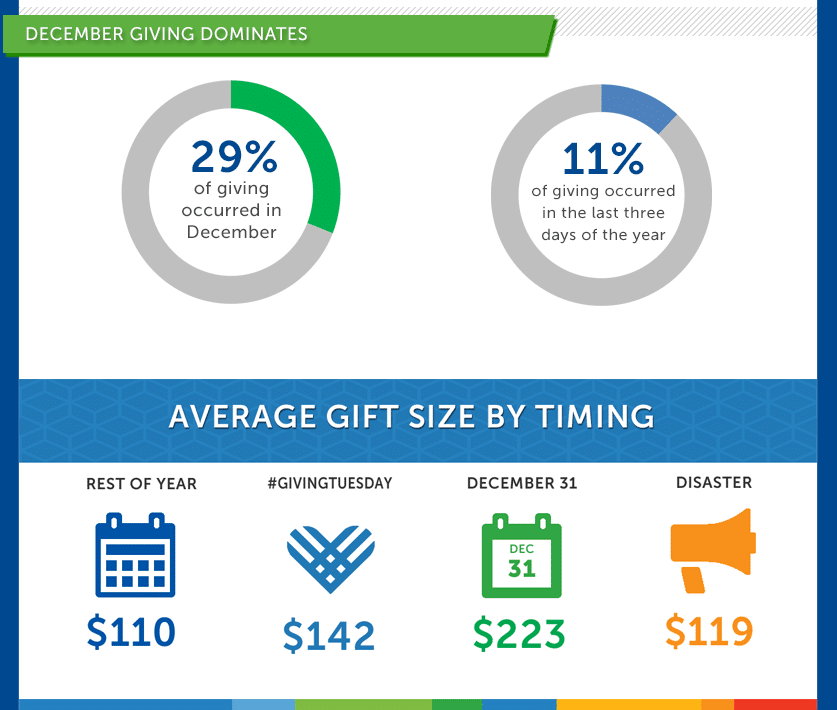
FACT: December giving accounts for 29% of all giving throughout the year

Source: http://www.nptechforgood.com

2. Does Your Campaign Focus on the Right Audience?

For a year-end campaign goal to be meaningful you should focus on getting the attention of the right people. We know that just because someone is Catholic doesn’t necessarily mean they share the same passion for our causes. Therefore, it is important to focus on energy on getting in front of the right Catholics.

We do this for two important reasons. The first is because when we focus our attention, we can spend more time with Catholics who will give. This, therefore, increases the number of gifts we receive. The second reason is that we reduce our stress levels. This is important because when we are speaking to people, they are more inspired to give to someone who is calm, composed, and happy. Plus it is Advent, and stress is not a gift of the Holy Spirit.

We find the right Catholics by taking time to review our year and reflect on who God has placed in our lives. When we connect the dots, and we identify the people who have crossed our paths, then we’re closing on finding the audience to ask for donations.

You won’t know whom to ask until you commit the time and effort to plan. Set your intention and get started with reviewing the past 11 months and recognize which people God placed in your path.

Brice Sokolowski Catholic Fundraiser

3. Are You Getting Personal with Your Approach?

There’s a difference between an appeal letter and genuine request. We all have received those direct mail letters that follow the same formula. These letters are so professionally done that they lack a personal touch.

What about the monastery who decides to build a new wing because more people are visiting for a retreat or considering a vocation? What about the Catholic apostolate that is increasing its online presence and reaching more lapsed Catholics? These are exciting stories, would you agree? It does until you read their appeal letters and how they forgot to share the unique aspect of their work.

But how do find your personal style when asking for donations?

Sometimes it’s just intuition. In his Total Consecration to Jesus through Mary, Saint Louis de Montfort asks us to spend at least twelve days emptying ourselves of the spirit of the world. He reminds us that before we can take a step forward, it’s prudent to stop and reflect.

Saint Louis shows us how moving from one desire to another (even if it is to do God’s will) has to be done with prudence and preparation. This is especially true when it comes to asking for money.

[Tweet “Saint Louis de Montfort reminds us to pause before charging forward.”]

Fundraising is a challenge, and if not properly planned, it can just turn into discouragement. What I like to do is set a December campaign goal that is motivating (and a bit discouraging) and then take time to plan. I make sure that I’m getting as personal with my approach and that my story is correctly told.

How to Plan for a Successful December with Fundraising?

As we move into December and the Advent season, try to organize your campaign so it is authentic, personal, and resonates with the right Catholics. It’s important to remember what fundraising campaigns are for in the first place. They are about raising funds to keep your mission moving forward, yes. But it’s more than that. A campaign is not just about what you raise. It’s about what you are doing for the Kingdom of God.

Campaigns are about moving forward. A good campaign requires us to strengthen our mission and do more for Jesus. That’s because every campaign is about Our Blessed Lord as much as—even more than— our vocation. And that’s precisely why planning your December fundraising in Catholic way is so important.

Every fundraising campaign must about Jesus as much as our goal to get donations.

For more information on how to plan your next campaign, make sure you download a free copy of ‘The 10 Commandments of Catholic Fundraising.’

[Tweet “Every fundraising campaign must about Jesus as much as our goal to get donations.”]

Question: What do you want to achieve this December with your fundraising?

Brice Sokolowski Catholic Fundraiser

How to Find More and More and More Donors (and then even more)

Most of us start with the idea that to raise funds we have to find donors all the time. Therefore, the hunt begins, and the fundraising strategy focuses on finding people and getting them to donate. Sounds like a logical approach to reach your target, but in fact, it’s not at all.

If you are fundraising like this, you’re running up a steep mountain, and in no time, you’ll run out of breath.

Fact: to find donors is difficult, and asking people for money is nauseating.

Well, it is for me, especially when the idioms we use when fundraising are: ‘it is better to give than receive’ and ‘God likes a joyful giver.’

How awful to say these lines every day in hope that people will send us gifts?

My response to this kind of fundraising is if it’s so great to give, why then are charities always asking? Why are they not giving more to Catholics, prospects, and their donors? Sure,  I do not argue that they are doing wonderful work through their mission, but to those they ask for donations, charities lean heavily on the receiving end. In my view, that puts them at risk of capsizing the boat.

I think this constant asking for money puts you, the fundraiser, in an awkward situation. I applaud you for using the funds to help others, but is that enough to inspire Catholics to donate to them? I don’t think so, and I have a better approach. My view is that it’s better for everyone to give, especially charities.

To find donors, shock Catholics by giving more to them (even before you ask)

My approach to fundraising is heavily influenced by the concept, ‘it is better to give than to receive.’ This is challenging for us fundraisers because our job is to collect donations. But just because something is a paradox doesn’t mean it’s not true. If anything, the truth is hidden within what looks complex. You just have to keep looking.

This concept of giving to your Catholics (especially your current donors) has everything to do with fundraising because more donations don’t always come from finding new people. In fact, the majority of donations will come from the people whom you already know.

You just have to look more closely.

Just because you meet someone, explain what you do, and they don’t give, doesn’t mean they will never be a donor. In fact, you have more chances of them becoming a donor than repeatedly asking new people.

Donors are people who recognize the importance of what you do. They have similar values to you. They have a similar vision. They see your plan for doing good as a way forward. Therefore, the way to find donors is to take a step back and first find people who share your passion, share this with them as often as possible, and don’t drop the relationship just because you didn’t score a donation.

Donations happen when you take the time to build relationships with Catholics.

Check out my article on the Generosity Factor for more ways of shocking Catholics with your new approach to fundraising.

The #1 factor why you aren’t getting more donors

This is the where most Catholic charities fail. They find a group of Catholics who have a general interest in their work and immediately ask. If the response is “no thank you”, the charity forgets about them and goes looking for another group (or parish) to ask.

This becomes a never-ending cycle of finding and asking.

I think this is wrong because you associate your relationship with someone on whether or not they immediately give. I’m going to assume that, as a fellow Catholic, you see the fault here. We as Catholics don’t base our relationships on what we can get out of others.

That’s utilitarianism.

Utilitarianism is a civilization of production and of use, a civilization of “things” and not of “persons”, a civilization in which persons are used in the same way as things are used. – Pope John Paul II, Letter to Families, 1994

We as Catholics are to base our relationships on the dignity of the other person. We focus on willing the good of the other.

Check out my article on the fantastic book: Why Catholics Don’t Give … and What to Do About it.

Why long-term relationships equals more donors

Your number one priority to increase your number of donors is retention. Retention is keeping a donor year after year. Most Catholic organizations don’t look at retention, and that’s why each year they are frantically looking for donors to reach their end of year target.

They have no idea how many of last year donors gave this year. They don’t know why they stopped giving. They don’t know why they continue to give.

In fact, they don’t know much at all about their donors. These are serious problems that must be resolved quickly.

You have to switch to a different approach to your donors. With the technology that we have today, there’s no reason you cannot contact each one individually and get to know them.

Email costs nothing.

Phone calls cost very little.

All you have to do is manage your list of donors. That’s it.

Will it require some time and effort on your side? Absolutely. But the return on receiving long-term sustainable funds is exponential. I know no better way to increase your funds than this way. As you keep more of your current donors, you spend more time to find donors that help you grow rather than just replace donors that leave.

So the question is: do you know the percentage of last year’s donors who are giving this year? If you don’t, or if it takes you a while to find it, I recommend you start accessing this information more quickly.

Take a minute to read my article on how to inspire Catholics to give more financially.

Example: I’m not lying. Check the numbers for yourself!

To show you how important retention is, let’s do the math. For every one donor that stops donating, you have to find two just to increase your number of donors. So if you have 100 donors, and 50 stop giving, you have to find another 100 to increase your donors to 150.

This means you spend 50% of your time getting back to your original number of 100 donors, and the other 50% of your time growing your number of donors to 150.

That’s pretty inefficient.

It is a lot more work to find new donors than it is to keep the ones you have. Therefore, we can assume you are spending about 75% of your time looking for 50 donors to replace the ones you lost, and 25% of your time actually looking for ones to increase your fundraising level. This is why I said in the beginning that if you are just looking for new donors, you are climbing up a mountain and this strategy is exhausting. Instead, focus on who God has already given you.

Consider this Catholic approach to relating with your donors

My recommendation is to focus your time on your current donors. Build relationships with them. Learn who they are. Thank them often. Listen to them. Find ways to get them more involved than just financially.

When you make every effort to keep your donors, you don’t have to find two new donors to grow. Therefore, you can spend more time to find donors.

You just have to find one after another. That’s much easier to do.

The Catholic way of developing relationships with donors and increasing your donor base requires more prayer, more attention to the person, and more willingness to depart from the formalities of conventional fundraising.

Pray – Take a piece of paper, separate it into 12 columns, one for each month, and reflect on how you can express your gratitude to your donors each month. How can you say thank you without attaching a donation request to your message?

Pray – Whether it’s offering Mass for your donors, saying a rosary, or praying for them at adoration, find your ways to bless them. Also, tell them that you are doing it. Share with your donors the different activities you do for them. Have them get involved.

Pray – I also recommend that you intercede for your donors. The best way to do this is by asking them for feedback and doing small tasks for them. Ask, “how can I better serve you and thank you for your generosity?” Then, take action.

Ask – Ask your donors to stay donors. Keep track of your retention. Follow-up with each donor. Track when their year anniversary of donating is coming up and reach out to them in advance. Let them know how thankful you will be if they continued giving. Then start looking for more donors, as you will have more energy and time to do so.


Question: How long does it take you to find your retention rate?
How to Fundraise after a Disaster (Hurricane Harvey & Irma)

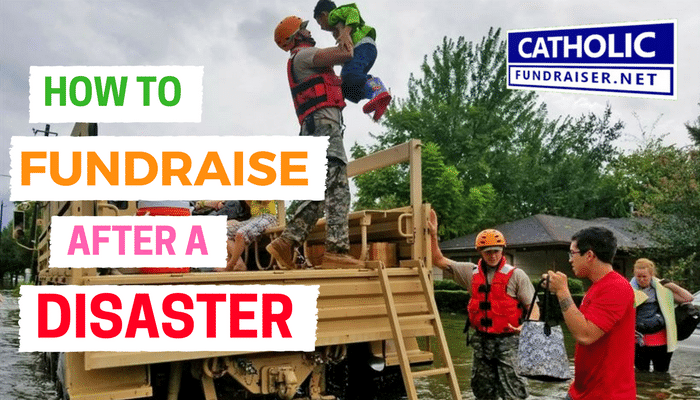
The level of destruction by Hurricane Harvey has been biblical. Like me, you have been following what’s been happening in Houston and the surrounding areas this past week. Residents have been pounded with rain, winds, tornadoes, and flooding. Now Hurricane Irma is on its way.

Fundraise Hurricane Harvey

As we watch the rescue efforts, we are all looking for ways to do our part. Perhaps you are thinking of:

Praying a novena
Travelling to Houston to help
Sending food and water
Connecting with locals in your area to organize a relief response
Donating money to a charity
Raising funds to support people you know

Today, we see the aftermath and look to rebuild. Many people have taken to social media and the internet to raise money.

While fundraising can help, I have learned how to raise money a much more effective way. Here are five strategies that I am currently using.

1. Focus on long-term fundraising.

While it’s good to ask for donations, organize your fundraising so you can ask today and in a few months. Check out this article for more details.

2. Ask for contact details as well as donations.

While you will get a surge of donations today, this response will wane quite quickly. Get people to stay informed on what’s happening by asking for the email, allowing you to ask for donations later on. Read this article to learn the benefits of asking for contact details.

3. Tell your story.

People are inspired to give when you share with them how things are moving forward. Keep people updated on how you are are rebuilding after the disaster. This motivates people to give. Read more about this topic here.

4. Don’t just ask for money.

Only a fraction of people will be able to donate. However, they can do other things, like provide resources and volunteer. Also, they may be able to donate later on. So make sure to get people involved in other ways. Check out this article on how to do this.

5. Thank people.

Make sure to thank people for their contributions. While the focus is helping people, it’s important to remember that relationships and community are as important as money. Take the time to thank people as intimately as possible (not just via a social media post). Read more about thanking people in this article.

Conclusion – Fundraising in the aftermath of a disaster

When it comes to fundraising after a disaster, we need to remember it’s not just about raising as many funds as possible. Suffice it to say, getting Houston back to normal will take time. Therefore, looking at fundraising in the long-term is more effective than just a short-burst of asking for money.

Focus on building relationships with the people God is placing in your life. This is the good that comes from these terrible events. As a result, you will build a network of friends, volunteers, and donors that will help you in the coming months and years.

Question: What’s your best fundraising strategy for rebuilding after a disaster? You can leave a comment below.